
What is Maundy Thursday?
Thursday in Holy Week
The Anglican calendar is ordered by a hierarchy of holy days, each carrying a different weight of observance. At the top sit the seven Principal Feasts. Below them are the Red-Letter Holy Days. And woven throughout the calendar are the Days of Discipline, Denial, and Special Prayer, listed on page 689 of the BCP 2019. Maundy Thursday is the third of these days, described in the BCP as a day "observed with rites recalling the Last Supper and betrayal at Gethsemane." It falls on the Thursday before Easter and marks the first movement of the Paschal Triduum, the sacred three days that carry the Church from the Upper Room through the cross and into the resurrection.
The term Maundy derives from the Latin mandatum, meaning commandment. It refers to Jesus' words in John 13:34, spoken at the Last Supper: "A new commandment I give to you, that you love one another: just as I have loved you, you also are to love one another." (John 13:34, ESV) This commandment to love is the heartbeat of the day, reflected in the service's readings, its foot-washing rite, and its solemn close. Maundy Thursday blends celebration and sorrow, drawing the faithful into the Upper Room where Jesus shared his last meal with his disciples, instituted the Eucharist, and prepared them for the betrayal that was already underway.
The Historical Development of Maundy Thursday
The observance of Maundy Thursday traces to the early centuries of the Church. By the fourth century, Christians in Jerusalem gathered to commemorate the Upper Room events, including the Eucharist and acts of charity. Early writers such as Tertullian reference foot-washing practices, which became more formalized in monastic and cathedral settings by the fifth century. The pedilavium, the washing of feet, served as a concrete expression of the mandatum.
In the medieval period, the day gained royal and civic dimensions. English monarchs, imitating Christ the servant-king, washed the feet of the poor and distributed alms. This practice evolved into the Royal Maundy Service, which continues today in the Church of England, though the physical washing was later replaced by specially minted Maundy Money. The Reformation preserved the day's scriptural focus, and the BCP 2019 retains the optional foot-washing rite and the stripping of the altar as part of the full observance. Maundy Thursday thus links the Upper Room to the early Church, medieval piety, and the reformed liturgy of Anglicanism today.
Maundy Thursday and the Paschal Triduum
Maundy Thursday does not stand alone. It is the first movement of the Paschal Triduum, the three days that the Church has always treated not as three separate events but as one continuous act of worship. There is no proper ending to the Maundy Thursday service and no proper beginning to the Good Friday liturgy; the two flow into each other, just as the Upper Room flows into Gethsemane, and Gethsemane flows to Golgotha.
At the close of the Maundy Thursday service, the altar is stripped, candles extinguished, linens removed, ornaments taken away, leaving the sanctuary absolutely bare. This stripping may occur in silence or accompanied by Psalm 22, whose opening cry anticipates the desolation of Good Friday. The congregation departs without a blessing or dismissal. That unresolved silence carries into Good Friday, creating the right atmosphere for honest confrontation with the cross. The Triduum is a single liturgical act, and Maundy Thursday is its beginning.
The Liturgy of Maundy Thursday
The Maundy Thursday service has three defining elements: the Liturgy of the Word and Eucharist, the foot-washing, and the stripping of the altar.
The readings draw the congregation into the full depth of the night. Exodus 12:1–14 recounts the Passover, the lamb, the blood on the doorposts, the night of the Lord's deliverance, connecting the institution of the Eucharist to the liberation of Israel. Psalm 78:15–26, the appointed psalm, is the great recital of God's provision in the wilderness, the manna and water from the rock that the Church has always read as types of the Eucharist. First Corinthians 11:23–26 is Paul's account of the tradition he received and passed on: "For I received from the Lord what I also delivered to you, that the Lord Jesus on the night when he was betrayed took bread, and when he had given thanks, he broke it." (1 Corinthians 11:23–24, ESV)And the Gospel, John 13:1–15 or Luke 22:14–30, brings the congregation into the Upper Room itself: the meal, the washing, the commandment, the shadow of betrayal already falling across the table.
The propers for this feast are found on page 722 of the BCP 2019 and are the same across all three years of the lectionary cycle, underscoring the theological concentration of the night whose events they mark.
The Foot-Washing
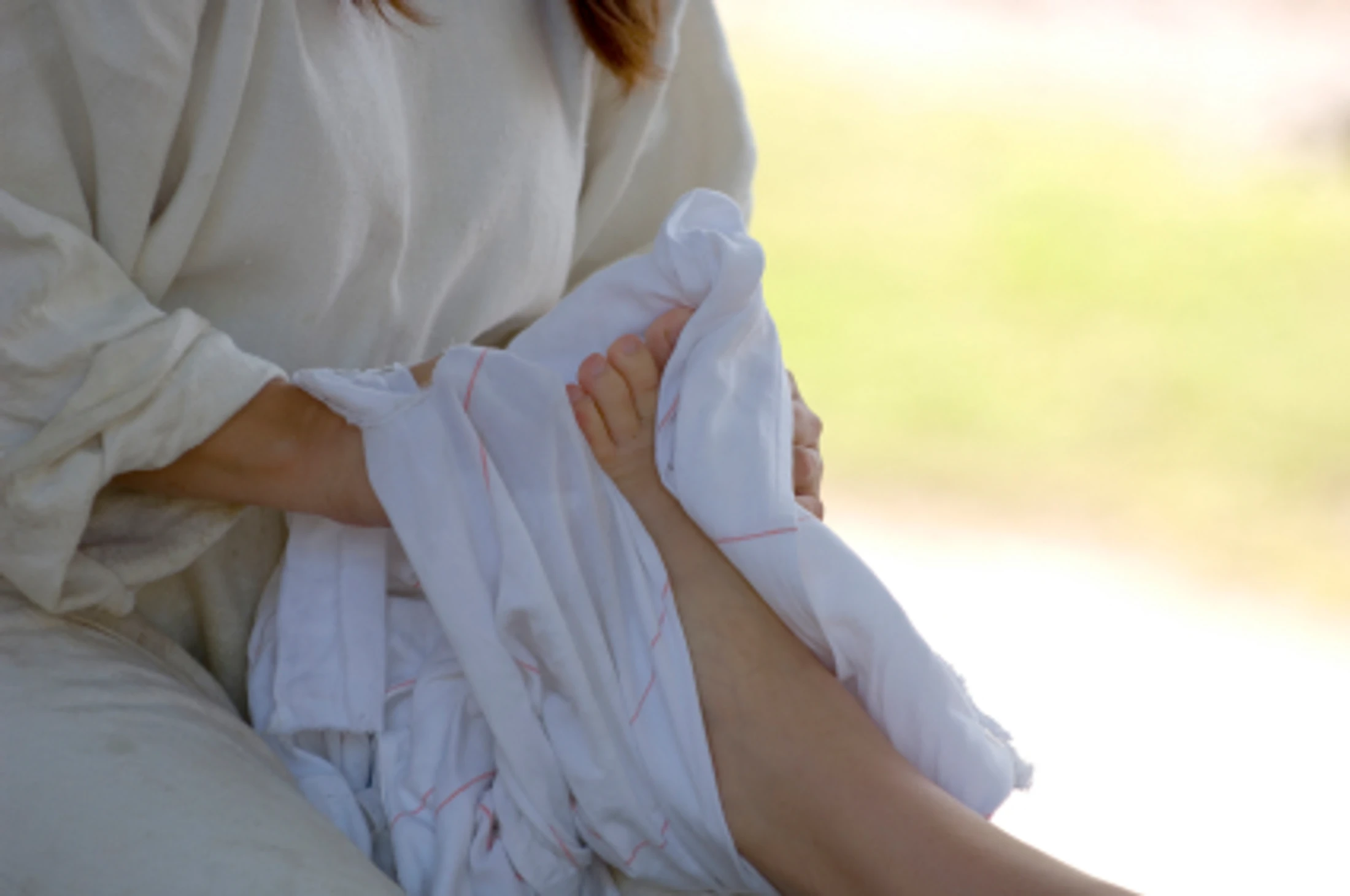
A distinctive feature of Maundy Thursday is the optional rite of foot-washing, the pedilavium. Jesus washes his disciples' feet in John 13:1–15, an astonishing act of humility from their Lord and Teacher, and then commands: "If I then, your Lord and Teacher, have washed your feet, you also ought to wash one another's feet. For I have given you an example, that you should do just as I have done to you." (John 13:14–15, ESV) In many Anglican parishes, the rite is participatory: clergy wash the feet of congregants, or members wash one another's, embodying the servant-leadership Christ modeled. Though optional, this tactile act makes the mandatum physical. The commandment to love is not merely spoken; it is performed, and the performance implicates everyone present.
Peter's initial refusal and then his wholehearted acquiescence in John 13:6–9 is the congregation's own experience in miniature: the instinct to keep a respectful distance from the Lord's humility, followed by the recognition that without it we have no part in him. The foot-washing confronts us with the truth that greatness in the Kingdom is measured by the depth of our service, and that the one who washes our feet is also the one who will carry our sin to the cross the next day.
The Institution of the Eucharist
At the heart of the day is the institution of the Holy Eucharist. On the night before he suffered, Jesus took bread, gave thanks, broke it, and gave it to his disciples with the words that the Church has repeated ever since. He took the cup and said: "This cup is the new covenant in my blood. Do this, as often as you drink it, in remembrance of me." (1 Corinthians 11:25, ESV) Paul's commentary follows immediately: "For as often as you eat this bread and drink the cup, you proclaim the Lord's death until he comes." (1 Corinthians 11:26, ESV) Every Eucharist is a proclamation of the Lord's death, not a repetition of it, but an announcement of it, a making-present of its benefits, a foretaste of the feast when he comes again. Maundy Thursday is the feast of the feast's institution: the night when the Lamb gave his people the meal through which they would encounter his sacrifice until his return.
It is common practice after the Maundy Thursday service to reserve the consecrated elements for use at the Good Friday liturgy. The altar that is stripped bare at the close of Thursday is the altar from which the reserved sacrament will be given on Friday, when no Eucharist is celebrated. The table spread for the disciples gives way to the hill where the host himself is broken and poured out, and the elements reserved from Thursday carry the connection between the two.
The BCP 2019 Collect and Preface
The BCP 2019 appoints the following collect for Maundy Thursday on page 607: "Almighty Father, whose most dear Son, on the night before he suffered, instituted the Sacrament of his Body and Blood: Mercifully grant that we may receive it in thankful remembrance of Jesus Christ our Lord; who in these holy mysteries gives us a pledge of eternal life; and who lives and reigns with you and the Holy Spirit, one God, for ever and ever. Amen." The collect is concentrated around two gifts: the sacrament instituted on the night of the betrayal, and the pledge of eternal life given through it. Both gifts come from the same source, the one who suffered, who gave himself in bread and wine before giving himself on the cross. The prayer asks simply that we would receive what has been given in thankful remembrance. Gratitude is the only appropriate posture on this night.
The Preface of Easter, found on page 154 of the BCP 2019, is used at the Eucharist throughout Holy Week: "But chiefly are we bound to praise you for the glorious resurrection of your Son Jesus Christ our Lord; for he is the true Paschal Lamb, who was offered for us, and has taken away the sin of the world; who by his death has destroyed death, and by his rising to life again has won for us everlasting life." (BCP 2019, p. 154) The use of the Easter preface on Maundy Thursday is not an anomaly but a theological statement: the cross and the resurrection cannot be separated. The Paschal Lamb who is about to be offered is the same one who will rise. The meal that anticipates his sacrifice also anticipates his victory. The Triduum is one act, and the preface that governs it speaks of the whole.
Gethsemane and the Close of the Service
In some parishes, following the stripping of the altar, a period of watching is kept, an hour of silent prayer before the reserved sacrament, recalling Jesus' agonized prayer in Gethsemane and his word to the disciples: "could you not watch with me one hour?" (Matthew 26:40, ESV) This practice is not mandated by the BCP but is a rich extension of the liturgy's movement into the night of betrayal. The congregation that has received the Eucharist now sits with the one who instituted it in the shadow of the cross.
The service ends without blessing or dismissal. Like Good Friday, Maundy Thursday does not conclude; it simply stops. The story is still moving, and the rite refuses to pretend otherwise. The bare sanctuary, the extinguished candles, and the silence are not statements of despair but of faithful waiting, the waiting of those who know that this Thursday night is the darkness before a dawn that death will not be able to stop.
Conclusion
Maundy Thursday unfolds as sacred drama, drawing the faithful into the Upper Room and toward the foot of the cross. It is the night of the new commandment and the new covenant, the night when the Shepherd gave his flock the meal through which they would proclaim his death until his return. The foot-washing, the Eucharist, the stripped altar, and the silence all form the whole person, body and soul, for the weight of what is coming.
"A new commandment I give to you, that you love one another: just as I have loved you, you also are to love one another."(John 13:34, ESV)