
What is the Feast of the Conversion of Paul the Apostle?
Feast Day: January 25
The Anglican calendar is ordered by a hierarchy of holy days, each carrying a different weight of observance. At the top sit the seven Principal Feasts, the highest days of the liturgical year. Below them are the Red-Letter Holy Days, appointed in the BCP 2019 with their own collects, propers, and lectionary readings, listed on page 688. They are called Red-Letter Days because, in the tradition of printing church calendars, these days appear in red ink, distinguished from the Optional Commemorations which appear in ordinary type.
The Feast of the Conversion of Saint Paul the Apostle, observed on January 25, is one of these Red-Letter Holy Days. It is one of the more unusual feasts in the Anglican calendar because it commemorates not the apostle’s birth or death, but the decisive moment when the risen Christ confronted his persecutor and made him an apostle. The man who had become one of the early Church’s fiercest enemies was stopped on the road to Damascus and eventually became the great apostle to the Gentiles.
The feast is also, in its own way, a feast of the Gospel’s reach. Paul was not seeking Christ. He was hunting Christians. He was not waiting for a religious experience. He was carrying letters authorizing arrest. And into that mission of violence, the risen Christ appeared, blinding, naming, questioning, and commissioning him.
The Conversion of Paul is among the Church’s most dramatic demonstrations that the grace of God is not limited by human resistance. Christ can arrest the committed opponent of the faith in the very midst of his opposition. The feast of January 25 exists to make sure the Church never forgets this.
The Road to Damascus
Paul’s conversion is recorded three times in the book of Acts, in chapters 9, 22, and 26, and Paul himself refers to it in his letters, most directly in Galatians 1 and 1 Corinthians 15. The appointed reading for this feast is Acts 26:9–21, Paul’s defense before King Agrippa, which gives us Paul’s own retelling of the encounter in the context of his apostolic mission.
Paul begins by acknowledging who he was: “I myself was convinced that I ought to do many things in opposing the name of Jesus of Nazareth. And I did so in Jerusalem. I not only locked up many of the saints in prison after receiving authority from the chief priests, but when they were put to death I cast my vote against them.” (Acts 26:9–10, ESV)
This is not the retrospective confession of a man minimizing his past. Paul is speaking before a king, and he is being precise. He was not a passive bystander to the persecution. He imprisoned Christians, approved when they were put to death, and pursued the Church with authority entrusted to him by the chief priests.
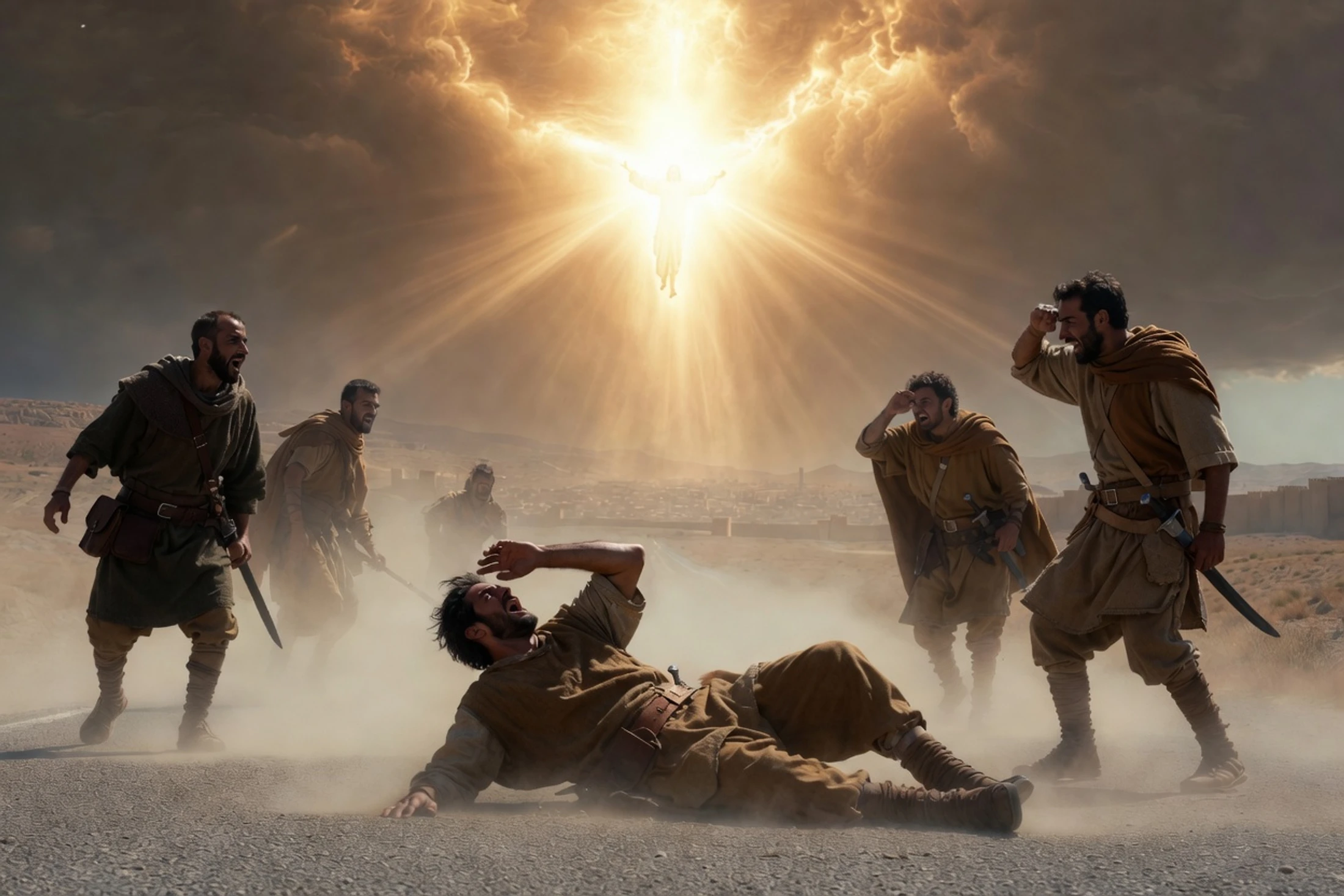
And then came the Damascus road. In verses 13 through 15: “At midday, O king, I saw on the way a light from heaven, brighter than the sun, that shone around me and those who journeyed with me. And when we had all fallen to the ground, I heard a voice saying to me in the Hebrew language, ‘Saul, Saul, why are you persecuting me? It is hard for you to kick against the goads.’ And I said, ‘Who are you, Lord?’ And the Lord said, ‘I am Jesus whom you are persecuting.’” (Acts 26:13–15, ESV)
Three details deserve attention. First, the light is brighter than the midday sun. This is not presented as a private dream or inward impression. The light surrounds Paul and his companions, they fall to the ground, and Paul encounters the risen Christ in what he will shortly call “the heavenly vision.” (Acts 26:19, ESV)
Second, the voice addresses Saul in the Hebrew language, the language of his Jewish religious world. The risen Jesus confronts him from within the very scriptural world Saul believed he was defending.
Third, there is the question: “Why are you persecuting me?” The risen Christ identifies himself with the Christians Paul is arresting. Paul has been laying hands on men and women, dragging them toward prison, but Jesus says that the persecution is directed against him. To persecute Christ’s people is to persecute Christ himself.
The commission follows immediately in verses 16 through 18: “But rise and stand upon your feet, for I have appeared to you for this purpose, to appoint you as a servant and witness to the things in which you have seen me and to those in which I will appear to you, delivering you from your people and from the Gentiles, to whom I am sending you to open their eyes, so that they may turn from darkness to light and from the power of Satan to God, that they may receive forgiveness of sins and a place among those who are sanctified by faith in me.” (Acts 26:16–18, ESV)
The man who came to Damascus to close eyes is sent to open them. The persecutor becomes the sent one. The man who handed Christians over to prison is commissioned to proclaim deliverance from the power of Satan. The reversal is total, and it is the risen Christ who accomplishes it.
Paul’s Own Account
The appointed Epistle reading is Galatians 1:11–24, Paul’s own theological account of what happened in connection with his calling. He insists from the outset that the Gospel he preaches did not originate with human tradition or apostolic instruction: “For I would have you know, brothers, that the gospel that was preached by me is not man’s gospel. For I did not receive it from any man, nor was I taught it, but I received it through a revelation of Jesus Christ.” (Galatians 1:11–12, ESV)
This claim is foundational to Paul’s defense of his apostolic ministry. He insists that the Gospel he preached was not derived from the Jerusalem apostles but came to him through revelation of Jesus Christ.
Paul then describes what followed. He did not immediately go to Jerusalem. He went away into Arabia and later returned to Damascus. Paul does not tell us exactly what occupied that period. His point in Galatians is chronological and theological: his Gospel was not formed by first traveling to Jerusalem and receiving instruction from those who were apostles before him.
Only after three years did he go to Jerusalem to visit Cephas, or Peter, staying with him fifteen days and seeing no other apostle except James, the Lord’s brother.
Paul continues: “And I was still unknown in person to the churches of Judea that are in Christ. They only were hearing it said, ‘He who used to persecute us is now preaching the faith he once tried to destroy.’ And they glorified God because of me.”(Galatians 1:22–24, ESV)
The churches of Judea, communities that had known him by reputation as their persecutor, now heard that the man who had tried to destroy the faith was preaching it. Their response was not merely amazement. They glorified God.
Paul’s conversion was intensely personal, but it did not remain private. Its effects became publicly known throughout the Church.
The Appointed Readings
The propers for this feast are found on page 730 of the BCP 2019. The appointed readings illuminate Paul’s calling from different angles and together build a remarkably coherent picture of what divine grace looks like when it reaches an unlikely recipient and then sends him into the world.
Psalm 67 is the appointed psalm, and it is one of the great missionary psalms of the Psalter: “May God be gracious to us and bless us and make his face to shine upon us, that your way may be known on earth, your saving power among all nations.” (Psalm 67:1–2, ESV)
Paul’s apostolic mission becomes one answer to this ancient prayer. The light that shone on the Damascus road sends Paul outward toward the nations. Across Asia Minor, Macedonia, Greece, and eventually toward Rome, he proclaims the saving power of the God of Israel among the Gentiles. Psalm 67 ends with the vision that “all the ends of the earth” will fear God, and Paul spent the remainder of his life carrying the Gospel toward those ends.
The appointed Gospel is Matthew 10:16–25, the middle section of the commissioning discourse in which Jesus prepares the Twelve for what they will face: “Behold, I am sending you out as sheep in the midst of wolves, so be wise as serpents and innocent as doves.” (Matthew 10:16, ESV)
This is a deliberately sobering Gospel for a feast of apostolic calling. Jesus does not promise safety or ease. He warns of arrests, floggings, trials, hatred, and persecution.
And one verse in particular fits the appointed reading from Acts with remarkable precision: “You will be dragged before governors and kings for my sake, to bear witness before them and the Gentiles.” (Matthew 10:18, ESV)
In Acts 26, that is exactly where Paul stands. The apostle is before King Agrippa, bearing witness to the risen Christ and recounting the commission that sent him to the Gentiles. The warning Jesus gave his first apostles becomes, in Paul’s life, a description of apostolic ministry.
Paul’s life reads almost like an extended commentary on this passage. He would be imprisoned, beaten, stoned, shipwrecked, opposed by both Jews and Gentiles, and brought before rulers because of the Gospel. According to ancient Christian tradition, his ministry finally ended in martyrdom at Rome.
Verse 24 therefore applies with particular force: “A disciple is not above his teacher, nor a servant above his master.”(Matthew 10:24, ESV) Paul’s sufferings were not evidence that his apostolic mission had failed. They followed the pattern of the crucified and risen Lord who sent him.
The BCP 2019 Collect and Preface
The BCP 2019 appoints the following collect for the feast on page 626: “O God, by the preaching of your apostle Paul you have caused the light of the Gospel to shine throughout the world: Grant, we pray, that having his wonderful conversion in remembrance, we may show ourselves thankful to you by following his holy teaching; through Jesus Christ our Lord, who lives and reigns with you, in the unity of the Holy Spirit, one God, now and for ever. Amen.”
The collect does two things simultaneously. It celebrates what God accomplished through Paul, “the light of the Gospel”shining throughout the world, and then turns that remembrance toward the life of the Church. Gratitude for Paul’s conversion is expressed not merely by admiring it at a distance, but by following his holy teaching.
That makes the feast more than a commemoration of someone else’s extraordinary experience. The Church remembers what God did in Paul and then asks what faithful gratitude for that grace looks like in us.
The Preface of Apostles, found on page 155 of the BCP 2019, is used at the Eucharist for this feast: “Through the great shepherd of your flock, Jesus Christ our Lord, who after his resurrection sent forth his apostles to preach the Gospel and to teach all nations, and promised to be with them always, even to the end of the ages.” (BCP 2019, p. 155)
The preface is especially fitting here. Paul’s commission came from the risen Christ, the great shepherd who sends his apostles to preach the Gospel and teach the nations. The Damascus road encounter does not reveal a different Christ or a different Gospel. The same risen Lord who appeared to Peter and the others also appeared to Paul and sent him.
Paul’s Apostolic Standing
Paul was not one of the original Twelve. He was not among those who accompanied Jesus throughout his earthly ministry, and he was not chosen by lot like Matthias.
His apostolic claim rests upon the appearance of the risen Christ, Christ’s calling and commission, and the ministry that followed. Paul defends that claim explicitly in 1 Corinthians 9:1: “Am I not an apostle? Have I not seen Jesus our Lord?” (1 Corinthians 9:1, ESV)
In 1 Corinthians 15, Paul places Christ’s appearance to him in the same sequence as the resurrection appearances to Cephas, the Twelve, James, and the other apostles. Finally, he says: “Last of all, as to one untimely born, he appeared also to me.” (1 Corinthians 15:8, ESV)
Paul never treats his apostleship as an achievement. Quite the opposite. He immediately calls himself “the least of the apostles, unworthy to be called an apostle, because I persecuted the church of God.” Then comes the explanation for everything that followed: “But by the grace of God I am what I am.” (1 Corinthians 15:9–10, ESV)
That sentence may be the best commentary Paul ever gave on the Damascus road.
His apostolate is extraordinary, but it is not merely the product of a private mystical experience. Paul claims that the objectively risen Jesus who appeared to the other apostolic witnesses appeared also to him, called him, and sent him. His ministry was subsequently recognized by the wider apostolic Church even as Paul vigorously insisted that its source was Christ himself.
The Anglican calendar gives particular attention to this calling by observing the Conversion of Saint Paul on January 25, while also commemorating Peter and Paul together on June 29. January 25 focuses the Church’s attention specifically on the extraordinary moment when the persecutor of Christ’s people encountered their risen Lord and was made his witness.
Observing This Feast
The Conversion of Saint Paul is observed on January 25, during the season of Epiphany. It is a Red-Letter Holy Day in the BCP 2019, one of the major holy days of the Anglican calendar. When January 25 falls on a Sunday outside Advent, Lent, or Easter, the BCP permits the feast to be observed on that Sunday. Alternatively, it may be transferred to the nearest following weekday. (BCP 2019, p. 689)
The liturgical color for the feast is white. Although Paul would eventually die as a martyr, January 25 does not commemorate his martyrdom. It commemorates his encounter with the risen Christ, his conversion, and his apostolic calling. White is especially fitting during Epiphany, a season concerned with the manifestation of Christ, and here the imagery is particularly vivid: a heavenly light brighter than the midday sun, the revelation of the risen Lord, and the grace of God breaking into the life of a man who had been walking in violent opposition to Christ.
The color also helps distinguish this feast from those that commemorate apostolic martyrdom. The focus of January 25 is not the blood Paul would eventually shed for Christ, but the grace by which Christ first laid hold of Paul.
The feast also stands exactly one week after the Confession of Saint Peter on January 18, another feast whose liturgical color is white. Together they form a striking pair within the season of Epiphany. At Caesarea Philippi, Peter receives revelation from the Father and confesses Jesus: “You are the Christ, the Son of the living God.” (Matthew 16:16, ESV) On the road to Damascus, Paul encounters the risen Christ who declares, “I am Jesus whom you are persecuting.” (Acts 26:15, ESV)
Peter receives revelation and confesses. Paul receives revelation and is converted. Both revelations concern the identity of Jesus. Both come by divine initiative. Both men are called and sent. Both will suffer for the Gospel. And both will ultimately be remembered together on June 29, the Feast of Saint Peter and Saint Paul.
To observe the Conversion of Saint Paul, pray the collect from BCP 2019, p. 626, and read the appointed lessons: Acts 26:9–21, Psalm 67, Galatians 1:11–24, and Matthew 10:16–25.
Notice how the readings interpret one another. Psalm 67 prays that God’s saving power may be known among all nations. Christ commissions Paul to carry that Gospel to the Gentiles. Matthew warns that the apostles will be brought before governors and kings as witnesses, and Acts places Paul before King Agrippa doing exactly that.
Then consider the question the feast places before the Church: What does Paul’s conversion teach us about the reach of grace? The man traveling to Damascus to arrest Christians became the man sent to open the eyes of the nations. The Church remembers his conversion not merely because Paul changed, but because Christ acted.
The proper response is therefore the one named in the collect: thanksgiving expressed by receiving and following the apostolic teaching that God caused to shine throughout the world through him.
Conclusion
The Conversion of Paul is a feast of God’s sovereign freedom in the calling of his servants.
Paul was not moving toward Christ. He was moving against Christ. He was not on pilgrimage toward Damascus looking for answers. He was traveling there with authority to arrest the followers of Jesus.
Christ stopped him.
The grace that reached Paul was not the reward of spiritual searching. It was the interruption of spiritual hostility. The risen Christ confronted him in the middle of his rebellion, named what he was doing, and then did something astonishing: he commissioned the persecutor to become a witness.
The one who had come to close eyes was sent to open them. The one who had tried to destroy the faith became its preacher. The man who entered the story breathing threats against Christians would eventually describe himself with the words, “By the grace of God I am what I am.” (1 Corinthians 15:10, ESV)
And the grace that called him did not merely rescue him from something. It sent him toward something. Christ told Paul that he would carry the Gospel to the Gentiles, “to open their eyes, so that they may turn from darkness to light and from the power of Satan to God.” (Acts 26:18, ESV) The conversion and the commission belong together.
That is why the collect speaks not merely of Paul being converted but of God causing “the light of the Gospel to shine throughout the world” through his preaching. The man who had tried to extinguish the Church became one of the instruments through whom Christ spread his Gospel among the nations.
Everything Paul would later write about grace, the cross, justification by faith, reconciliation with God, the inclusion of the Gentiles, and the new life found in Christ bears the mark of a man who knew that salvation began not with his reaching for Christ, but with Christ laying hold of him.
The grace of Christ reached a man who was actively resisting him. It found Paul in the middle of his rebellion, overcame his opposition, forgave his sin, and gave him a new vocation.
No sinner stands beyond the reach of that grace.